
Ainon
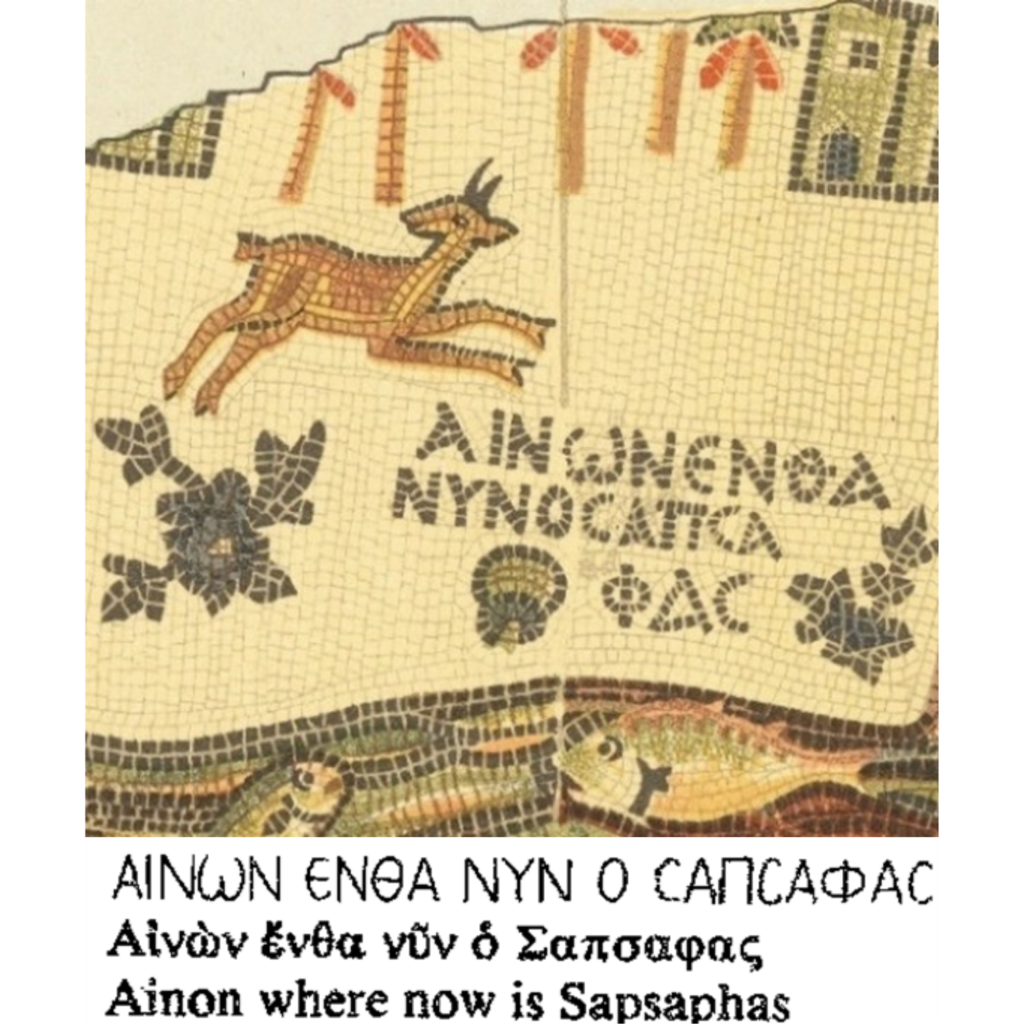
Pratum mentioned it under the name Sabsavas willow, an Aramaic word meaning willow tree (willow). Willow (Ain Nun) is mentioned in the Bible as another place of baptism by Saint John the Baptist. It is located in Wadi Al-Kharar on the eastern side of the Jordan River, and opposite it on the western side of the river is the main place of baptism of Saint John the Baptist. There is a monastery known as the Monastery of John the Baptist, which is recorded on the map of Madaba and is known as Beit Abra.
It is noted on the mosaic map drawn by Madaba at the site of Ain Nun, east of the river, that there is a small church at a water spring/small pond built by Patriarch Elijah of Jerusalem, and this site was mentioned by many travelers and monks who visited the area.
The name “Ain Noon” is Aramaic and means a flowing spring of water. The word “Ain” in Aramaic means eye of water (the same meaning in Arabic), and the “n” = n “means fertility, permanence, and abundance in Aramaic.
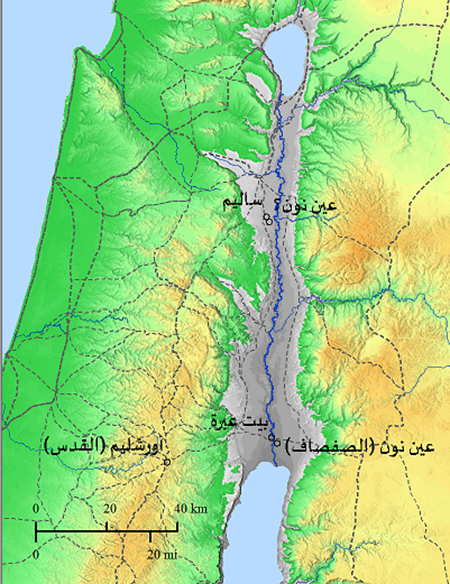
We found the name Ain Nun on the map of Madaba, located east of the Jordan River opposite Beit Abra. Bishop Eusebius identified this site in the fourth century AD, and stated that there was another site called “Ain Nun” near Beisan, located 53 Roman miles northeast of Jerusalem. However, this site has not received support from others, and another proposed site is Wadi al-Farra, which is also located northeast of Jerusalem. The third site is near the current village of Salim mentioned in the Bible.
Therefore, we conclude that the name Ain Nun spread widely in several regions of the Levant and Palestine, and therefore it is possible that the location of Ain Nun mentioned in the verse (John 3:23) goes back to the location near “Salim” south of Beisan, west of the river, or even the location mentioned in the map of Madaba east of the Jordan River opposite the location of “Beit Abra”. It is mentioned in the Gospel of John that Saint John the Baptist was also baptized at the site of Ain Nun, east of the river, meaning that this site was a second site (another baptism site) for Saint John the Baptist. The main site of baptism is in the Jewish area near Beit Abra, west of the river, where Saint John the Baptist was first baptized.
The archaeological map of Madaba identified the site of Ain Nun (Al-Saffasaf) in the eastern region of the Jordan River opposite the site of Beit Abra. A closed water spring and a church or small monastery appeared on the map, near “Ain Nun”, which was built by the Patriarch of Jerusalem, Elijah, in 518 AD. This was supported by the monk John Moschus (John Moschus) from Damascus, born around 550 AD and who knows the region well That is, the map of Madaba shows the presence of a closed water spring and a small church in the Ain Nun area east of the Jordan River, which is consistent with much of what travelers wrote.